Florida Handrail & Guard Code: Heights and Rules You Should Know
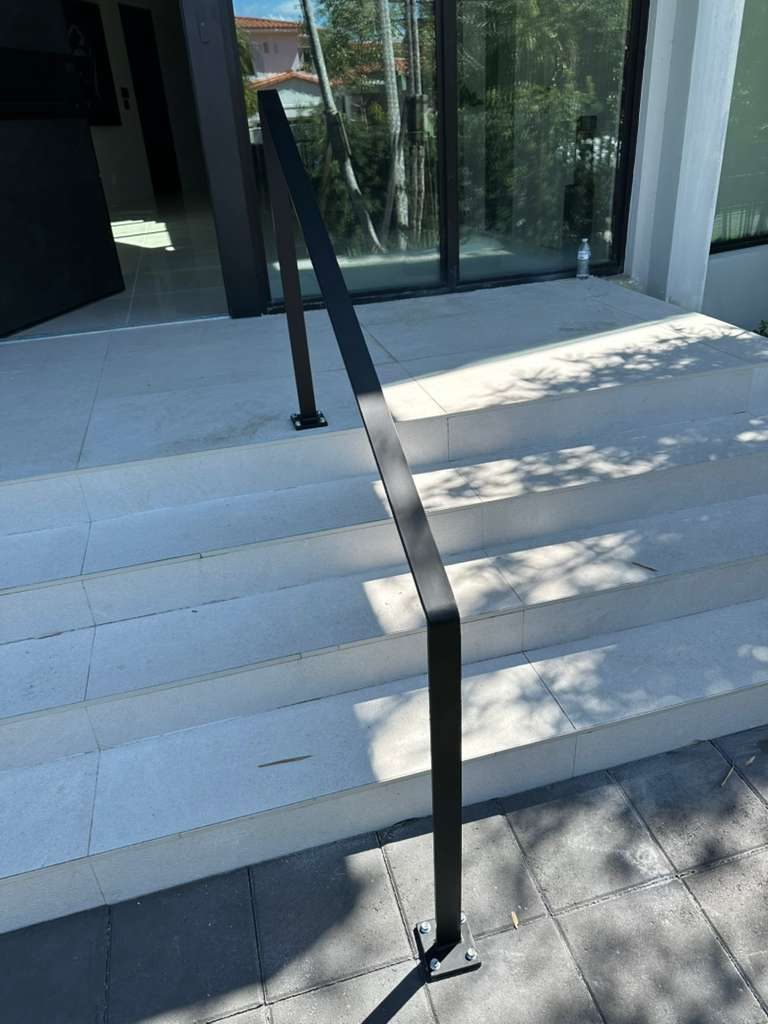
Planning a stair railing, balcony guard, or pool-area barrier in South Florida? A few code basics, sorted out before fabrication, save you from a failed inspection or a costly rebuild. Here's a plain-English rundown of the rules that matter most for handrails and railings, plus where to find the full technical reference.
Planning guidance only. This is general information, not legal advice, engineering, or a code interpretation. Requirements change by jurisdiction and code cycle, so always confirm your specific project with your local building department or a licensed design professional.
Handrail vs. Guardrail: They're Not the Same Thing
People use the words interchangeably, but the code doesn't, and the difference changes what gets built.
- A handrail is a graspable rail alongside a stair or ramp that you hold for support. Under the Florida Building Code, a handrail is generally required on stairs with four or more risers.
- A guard (guardrail) is a barrier that keeps people from falling off an elevated surface, a balcony, mezzanine, elevated walkway, or open-sided stair. A guard is generally required when a walking surface sits 30 inches or more above the floor or grade below.
The distinction matters structurally: a handrail carries grasping loads, while a guard has to resist people leaning and pushing against it. A system that looks like a guard but is only built like a handrail may not pass inspection.
The Heights and Dimensions That Matter
Florida adopts the International Building Code (IBC) with state amendments, and the Florida Residential Code (FRC) for one- and two-family homes. The figures most projects come down to:
- Guard height: generally at least 42 inches in commercial occupancies and 36 inches in residential (one- and two-family dwellings).
- Handrail height: handrails are commonly mounted in the 34-to-38-inch range measured above the stair nosing, per the IBC and Florida Residential Code.
- Graspability: a handrail has to be easy to grip, round profiles are typically 1.25 to 2 inches in diameter.
The 4-Inch Sphere Rule
One of the most-missed requirements: the openings in a guard's infill can't allow a 4-inch sphere to pass through. It's a child-safety standard, and it applies to most residential and commercial guards. Occupancies serving children may face stricter limits from the local AHJ. This rule drives a lot of design decisions, baluster spacing, cable tension, picket gaps, and it's an easy one to get flagged on if it's not planned up front.
It Has to Be Strong, Not Just Tall
Height and spacing are only half the picture. The top rail of a guard must be able to resist a 200-pound concentrated load applied in any direction. A railing that looks right but isn't engineered and anchored for that load is both a code problem and a real safety risk. This is why how a railing attaches to the structure matters as much as the railing itself.
Where Field Conditions Change the Answer
Those are the minimums. In the real world, the site keeps a vote:
- Uneven terrain at the base of a stair changes the guard height at the bottom landing.
- Existing tile, wood, or concrete affects which anchoring system is feasible.
- Older construction may not have framing that supports the required post embed depth.
For any permit-required or commercial work, those conditions should be assessed at field measurement, before anything is cut, which is exactly how we approach a handrail or railing job. Pool-area barriers carry their own rules; see our pool barrier & exterior railing notes.
How Fine Edge Fits In
Fine Edge designs and fabricates railings to match the code dimensions confirmed at field measurement, and we install them anchored for the loads the code expects. We do not issue engineering certifications, permit applications, or licensed design-professional services, on permit-required work, the engineer of record and the permit applicant are separate roles from the fabricator. For the full technical breakdown, see our Florida Handrails & Guards reference.
Need a Code-Minded Handrail or Guard?
Share your stair or balcony details and site conditions, and we'll fabricate to the specification confirmed at field measurement. Serving Miami-Dade, Broward, and Palm Beach.
Get a Free Quote